



PT-141 vs Sildenafil (Viagra): Different Paths to the Same Goal


Key Takeaways
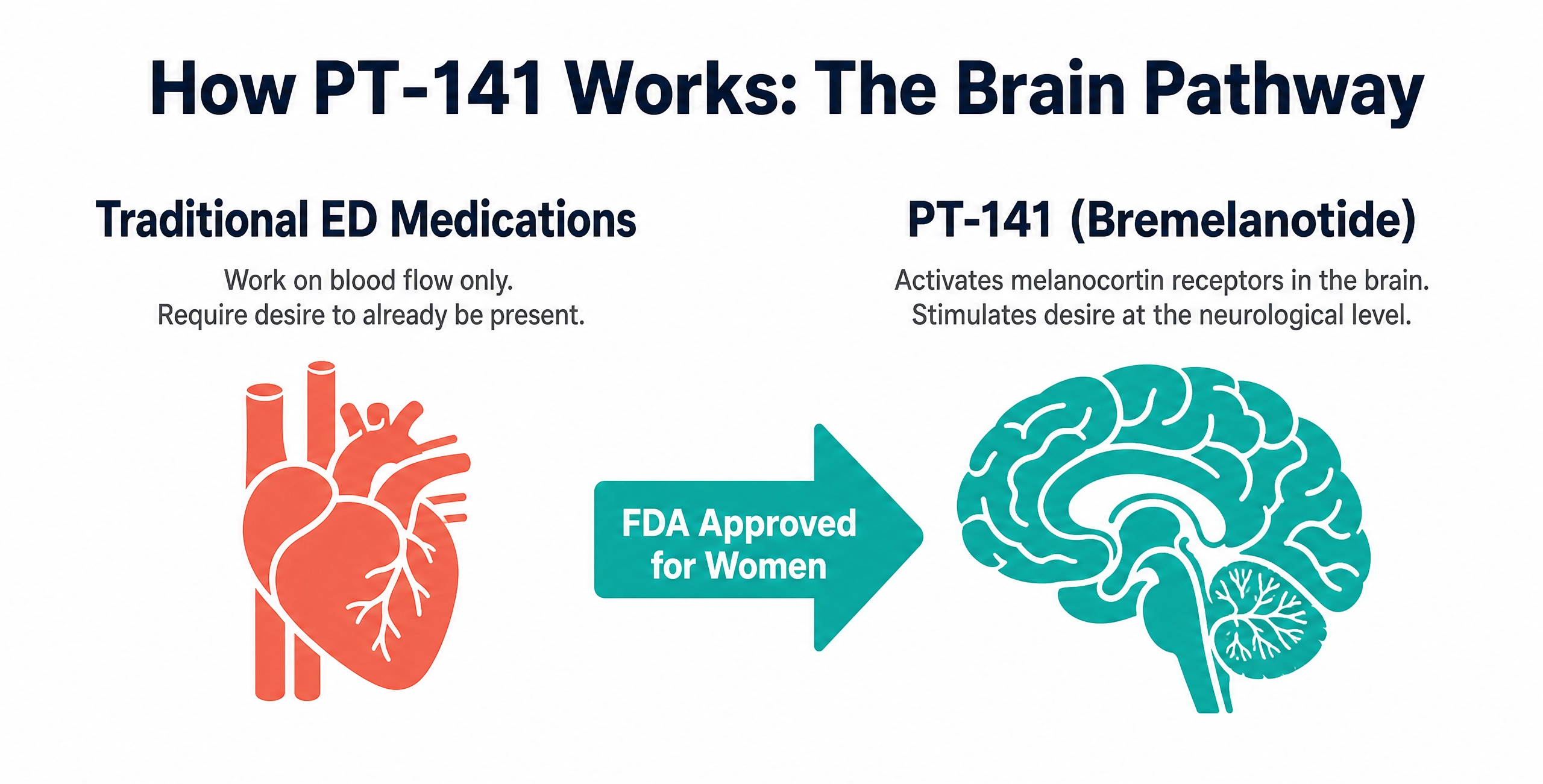
- The PT-141 peptide (bremelanotide) works in the brain to spark desire. Sildenafil (Viagra) works in the blood vessels to support an erection. They solve different problems.
- Sildenafil increases blood flow to the penis during sexual stimulation. Desire still has to be there first. It just helps the body follow through.
- Sildenafil is FDA-approved for erectile dysfunction. Bremelanotide is FDA-approved for low sexual desire in premenopausal women and is used off-label as PT-141 for men.
- PT-141 for men is often the next step for those who have tried sildenafil without success, especially when low desire, not blood flow, is the real issue.
- Sildenafil cannot be combined with nitrates. The combination can cause a dangerous drop in blood pressure. PT-141 side effects are different and do not include this risk.
What Is PT-141 Used For? Understanding the Two Kinds of Sexual Dysfunction
Sexual dysfunction isn’t just one thing. It is an umbrella term that covers a wide range of experiences. The underlying cause shapes everything about which treatment is likely to help.
For men, the most common symptom is erectile dysfunction (ED), the inability to get or maintain an erection firm enough for sexual activity. ED becomes more common with age, affecting about 30 million men in the US.1 It’s closely tied to cardiovascular health, since erections depend on healthy blood flow. Conditions that increase the risk include:
- high blood pressure
- diabetes
- high cholesterol
- obesity
- stress
- anxiety
- certain medications
For women, the picture is often different. The most common complaint is not a mechanical one. It’s a loss of desire. Hypoactive sexual desire disorder (HSDD) can cause persistent lack of interest in sexual activity that causes personal distress.2 It is not about physical function, it’s about the brain’s motivation and reward pathways going quiet.
This mechanical vs. motivational difference is exactly why sildenafil and the PT-141 peptide exist in different categories. One was built to solve a blood flow problem. The other, to address what happens in the brain.
How Sildenafil Works When the Body Needs a Little Help
When the FDA approved sildenafil in 1998 it was a game-changer for the treatment of ED.1 Before that, options were limited and often invasive. After it, millions of men had access to a simple oral medication that worked reliably.
It belongs to a class of drugs known as phosphodiesterase type 5 (PDE5) inhibitors that work in the blood vessels of the body.
During sexual stimulation, nitric oxide is released in the erectile tissue, triggering a molecule called cyclic guanosine monophosphate (cGMP) to be released. That molecule relaxes muscles in the blood vessels, allowing blood to flow in and create an erection. Sildenafil blocks PDE5 an enzyme that breaks down cGMP. By blocking PDE5, sildenafil lets cGMP build up and do its job longer.1

The key thing to understand is that sildenafil does not create desire. It just makes it easier for the body to follow through once desire and stimulation are present. In the landmark clinical trial published in the New England Journal of Medicine, 69 percent of attempts at sexual intercourse were successful for men receiving sildenafil, compared to 22 percent for those receiving a placebo.3
What Is PT-141? When the Issue Starts in the Brain
PT-141, also known by its generic name bremelanotide, takes an entirely different approach. It doesn’t touch blood flow at all. Instead, it works directly in the central nervous system.2
PT-141 is a melanocortin receptor agonist. It activates these receptors in the hypothalamus, the part of the brain that regulates arousal, motivation, and desire. By stimulating these pathways, it essentially turns the volume up on the neurological signals that drive sexual interest.2
This is a meaningful distinction. Because PT-141 works centrally. It does not require sexual stimulation to initiate a response. It’s not enabling a physical reaction. It’s influencing the brain’s motivation for sex.
In 2019, the FDA approved bremelanotide under the brand name Vyleesi as an as-needed treatment for low sexual desire (HHSD) in premenopausal women.4 For women who have watched their desire fade, PT-141 offers a way to address the actual source of the problem.
While not FDA-approved for men, researchers have studied PT-141 for patients who haven’t responded well to sildenafil or similar medications.5

Did You Know?
While sildenafil was originally developed as a cardiovascular drug to treat angina, PT-141 was developed from Melanotan II, a peptide initially researched as a sunless tanning agent that produced unexpected arousal side effects during early testing.
Sildenafil and PT-141 Side Effects
Both of these medications carry distinct safety profiles that are worth understanding before starting either one.
Sildenafil has one critical and absolute contraindication: it must never be combined with nitrates, such as nitroglycerin. The combination can cause a severe, sudden, and potentially fatal drop in blood pressure.1 It should also be used with caution in patients with cardiovascular disease.
PT-141 side effects most commonly include nausea, which caused some clinical trial participants to stop taking it. It can also cause brief increases in blood pressure and decreases in heart rate after taking it.2 Chronic use has been associated with focal hyperpigmentation, a darkening of the skin particularly on the face and gums, which may not fully resolve after stopping the medication.4
Neither of these is a reason to avoid treatment. They are reasons to have the conversation with a qualified provider who can weigh the full picture.
PT-141 for Men and Women: Which One Is Right for You?
That depends on what is actually going on. In some clinical research, using both therapies together has been explored for difficult-to-treat cases, aiming to address both the neurological and vascular components at the same time.5 That kind of combination approach requires careful medical supervision, but it reflects how clinicians are starting to think about sexual dysfunction as a multi-layered issue.
The Verdict:
The right choice depends entirely on what is driving the dysfunction in the first place.
If desire is present but the body is not responding the way it used to, and especially if there are underlying cardiovascular risk factors, sildenafil is the well-established starting point. It’s widely studied, and accessible.
If the issue is more about desire itself, a quieting of interest that does not feel like a physical problem, then PT-141 may be more relevant, particularly for women with HSDD or men who have already tried PDE5 inhibitors without success.
Seeing a skilled peptide therapy provider is the best place to start.
Find a Provider
Connect with a qualified provider who can help you determine whether PT-141, sildenafil, or a combination approach is right for your situation.

PT-141, also known as bremelanotide, is a synthetic peptide that works in the central nervous system to stimulate sexual desire and arousal. Unlike traditional erectile dysfunction medications, the PT-141 peptide does not act on blood flow. Instead, it activates melanocortin receptors in the brain that regulate motivation and desire. It is FDA-approved to treat hypoactive sexual desire disorder (HSDD) in premenopausal women and is frequently used off-label for men.
Yes, clinical research and off-label use indicate that PT-141 for men can be effective, particularly for those whose erectile dysfunction is rooted in low desire or who have not responded to PDE5 inhibitors like sildenafil. Because the PT-141 peptide works in the brain rather than the blood vessels, it offers a different mechanism of action. Studies on bremelanotide for men show improvements in sexual desire and arousal in patients who did not respond to standard treatments.
Bremelanotide for women works by activating melanocortin receptors in the hypothalamus, the part of the brain responsible for desire and arousal. It is the only FDA-approved as-needed treatment for hypoactive sexual desire disorder (HSDD) in premenopausal women. Research on PT-141 for women shows meaningful improvements in the number of satisfying sexual events and reductions in distress related to low desire.
The FDA-approved bremelanotide dosage for women with HSDD is 1.75 mg, taken as needed before sexual activity. When used off-label, a PT-141 dosage for men or women varies depending on the provider’s protocol and the formulation provided by a compounding pharmacy. PT-141 dosage in mg can range depending on individual response. Always follow your prescribing provider’s exact instructions and never self-dose.
PT-141 (bremelanotide) has been studied in clinical trials and is FDA-approved for use in premenopausal women with HSDD. For off-label use in men, PT-141 peptide side effects are generally manageable, though nausea and brief blood pressure changes are common. PT-141 is not recommended for people with cardiovascular disease or uncontrolled high blood pressure. As with any investigational compound, it should only be used under the supervision of a qualified healthcare provider.
The effects of PT-141 can last significantly longer than traditional oral medications. While onset typically occurs within one to two hours, many patients report that the effects of a PT-141 peptide dosage can last 12 to 24 hours, and sometimes longer depending on individual metabolism and dose. The PT-141 half life is about 2.7 hours, but the functional effects on desire and arousal often much longer.
Yes, PT-141 for erectile dysfunction is an area of active clinical interest, particularly for men who have not responded to sildenafil or other PDE5 inhibitors. Because bremelanotide for men works centrally in the brain rather than on blood flow, it addresses cases where the underlying issue is neurological or desire-related rather than vascular. PT-141 for ED is used off-label and requires a prescription from a qualified provider.
Scientific References
- Smith BP, Babos M. Sildenafil. In: StatPearls [Internet]. Treasure Island (FL): StatPearls Publishing; 2023.
- Edinoff AN, Sanders NM, Lewis KB, et al. Bremelanotide for Treatment of Female Hypoactive Sexual Desire. Neurology International. 2022;14(1):75-88.
- Goldstein I, Lue TF, Padma-Nathan H, Rosen RC, Steers WD, Wicker PA. Oral Sildenafil in the Treatment of Erectile Dysfunction. New England Journal of Medicine. 1998;338(20):1397-1404.
- Food and Drug Administration. NDA 210557 Vyleesi (bremelanotide) injection. FDA.gov. 2019.
- Kim S, Cho MC, Cho SY, Chung H, Rajasekaran MR. Novel Emerging Therapies for Erectile Dysfunction. World Journal of Men’s Health. 2020;39(1):48-64.
Legal & Medical Disclaimer
The information provided on this page by PeptideMatch.io is intended solely for educational and informational purposes. It does not constitute, and should not be interpreted as, professional medical advice, diagnosis, or treatment. Always consult a licensed physician or qualified healthcare provider before beginning any therapy or making changes to an existing treatment plan. Retatrutide is investigational and is not FDA-approved. PeptideMatch.io does not prescribe, dispense, or endorse any specific therapeutic protocol. Individual results may vary, and no outcomes are guaranteed. Medication costs and availability can change.
This educational content is the exclusive intellectual property of PeptideMatch.io. Reproduction, distribution, republication, or transmission of this material, in whole or in part, in any form or by any means, is strictly prohibited without the prior written consent of PeptideMatch.io. For licensing or reprint inquiries, please contact content@peptidematch.io.
©2026 PeptideMatch.io. All rights reserved.
Related Posts

How these weight loss peptides work, and which may be right for

Energy decline, brain fog, slow recovery—NAD+ is at the center of all of it. Here are options to restore

The science behind using specific signaling molecules to help restore balance, stamina, and wellness during
Ready to take the next step?
Find a verified peptide therapy provider or list your practice and connect with patients actively seeking trusted care.