



BPC-157 vs. TB-500: Benefits, Risks, and Why They’re Restricted


When it comes to the best peptides for recovery, research often points to BPC-157 and TB-500. Both are studied for their ability to accelerate healing, reduce inflammation, and support tissue repair. But they’re not the same peptide, and they don’t work the same way. This article explores the difference between the two.
Key Takeaway
- TB-500 is a synthetic peptide studied for systemic tissue repair and recovery.
- BPC-157 is a synthetic peptide studied for localized healing of tendons, ligaments, and the gut.
- BPC-157 and TB-500 are often studied together because they target different healing pathways.
- Neither peptide is FDA-approved for human use. A licensed healthcare provider should guide any treatment.
Understanding BPC-157
Body Protective Compound-157 (BPC-157) is a synthetic peptide composed of 15 amino acids. In preclinical research, BPC-157 has demonstrated the ability to accelerate the healing of tendons, ligaments, muscles, and bone.1 It achieves this primarily by promoting angiogenesis, which is the formation of new blood vessels.

BPC-157 is based on a naturally occurring sequence found in human gastric juice, where its primary biological role is to protect and heal the lining of the stomach and intestinal tract.1 But research over the past two decades has revealed that its healing properties extend well beyond the gut.
By increasing blood flow to injured areas, particularly tissues like tendons that naturally have poor blood supply, BPC-157 delivers the oxygen and nutrients necessary for repair.1 It also controls the inflammatory response, shifting the body from a state of chronic inflammation toward active healing.1

Did You Know?
Tendons have one of the poorest blood supplies of any tissue in the body. This is why tendon injuries heal so slowly. BPC-157’s ability to stimulate new blood vessel growth makes it a particularly active area of study for tendon and ligament repair.
Understanding TB-500 (Thymosin Beta-4)
TB-500 is a synthetic version of thymosin beta-4 (TB4), a naturally occurring peptide made up of 43 amino acids. It’s found in almost all human and animal cells.2 TB-500 plays a critical role incellular regenerationand tissue repair, primarily through its interaction with a protein called actin.

Actin is essential for cell structure and movement. When tissue is injured, TB-500 binds to actin, regulating its availability and allowing cells to migrate to the site of the injury to begin the repair process.2
This mechanism makes TB-500 particularly effective for systemic healing, meaning it can circulate throughout the body and target multiple areas of damage or inflammation simultaneously.2 Research shows TB-500 supports the repair of muscle tissue, reduces scar formation, and promotes the survival of cells under stress.2
Side-By-Side Comparison
This table highlights the key practical and regulatory differences between BPC-157 and TB-500.
| Profile | BPC-157 | TB-500 |
|---|---|---|
| Class | Synthetic pentadecapeptide | Synthetic thymosin beta-4 analog |
| Approval Status | Not FDA approved | Not FDA approved |
| How to Obtain | Removed from compounding / Category 2 restricted; consult your provider for alternatives | Removed from compounding / Category 2 restricted; consult your provider for alternatives |
| Evidence Level | Extensive preclinical and animal data; limited human trials | Preclinical and animal data; some human trials for specific TB4 formulations |
| Doses Used in Research | 1-10 mcg/kg subcutaneously in animal models1 | 2-5 mg weekly or biweekly in animal models2 |
| Cost | Moderate; about $150-$300/month | Moderate to high; typically $200-$400/month |
| Side Effects | Generally well tolerated in animal research; long-term human safety data not established | Generally well tolerated in animal research; long-term human safety data not established |
Which Approach Is Right for You?
When considering BPC-157 and TB-500, the choice often comes down to the nature of the injury and the specific goals of the individual.

BPC-157 is often researched in treating acute, localized injuries such as a torn tendon, sprained ligament, or specific muscle strain. That’s because it can drive blood flow and targeted healing to a specific area. Its origins in the gut also make it a subject of interest for those exploring gastrointestinal health and systemwide inflammation reduction.
TB-500 is often studied for its broader, systemic healing capabilities. Because it regulates cell movement and tissue repair at the cellular level, it’s frequently considered for more widespread muscle recovery, chronic wear-and-tear, and overall cellular resilience. Its ability to circulate throughout the body and potentially support areas of damage makes it a topic of interest for those dealing with multiple sites of injury or ongoing inflammation.
When comparing BPC-157 and TB-500, they’re often discussed in terms of their different roles in the healing process:
- BPC-157: Studied for its potential role in localized repair processes, including tissue recovery and blood vessel formation.
- TB-500: Studied for broader, systemic effects related to cellular movement, tissue repair, and overall recovery support.
- Combined approach: Because the two peptides are associated with different mechanisms, they are frequently studied together as a way to explore a more comprehensive recovery strategy.
It’s important to consider the current regulatory landscape. Both peptides have faced significant compounding restrictions in the US as of 2024 and 2025, meaning access through traditional compounding pharmacies may be limited. A qualified healthcare provider is essential not only for guidance around any potential protocol but also for understanding current availability and regulatory considerations.
Safety and Risk Considerations
Any honest discussion of BPC-157 and TB-500 must address safety directly, and the picture here is complicated. In animal studies, BPC-157 and TB-500 have generally been well tolerated at studied doses. Reported side effects are typically mild and may include:
- Injection site reactions (redness, swelling, or pain)
- Fatigue or headaches
- Nausea or mild stomach upset
The more significant concerns involve potential biological risks and the lack of long-term human data:
- Cancer-related concerns: BPC-157 may influence blood vessel formation through the VEGFR2 pathway, which is also involved in tumor growth. While no human studies have shown that BPC-157 causes cancer, the theoretical risk remains a concern. Similar questions exist with TB-500 due to research involving thymosin beta-4 and tumor progression.
- Limited human research: As of 2025, human data on BPC-157 remains limited, and large-scale clinical trials for either compound are lacking. Long-term effects are still unknown.
- Product quality concerns: Because these compounds are not legally available through regulated compounding pharmacies in the US, products from unregulated sources may vary in quality, purity, and safety.
A 2026 analysis of 6,441 grey market peptide samples found that between 41.6% and 71.1% failed basic quality criteria, and 15% of samples tested positive for measurable endotoxin contamination.3
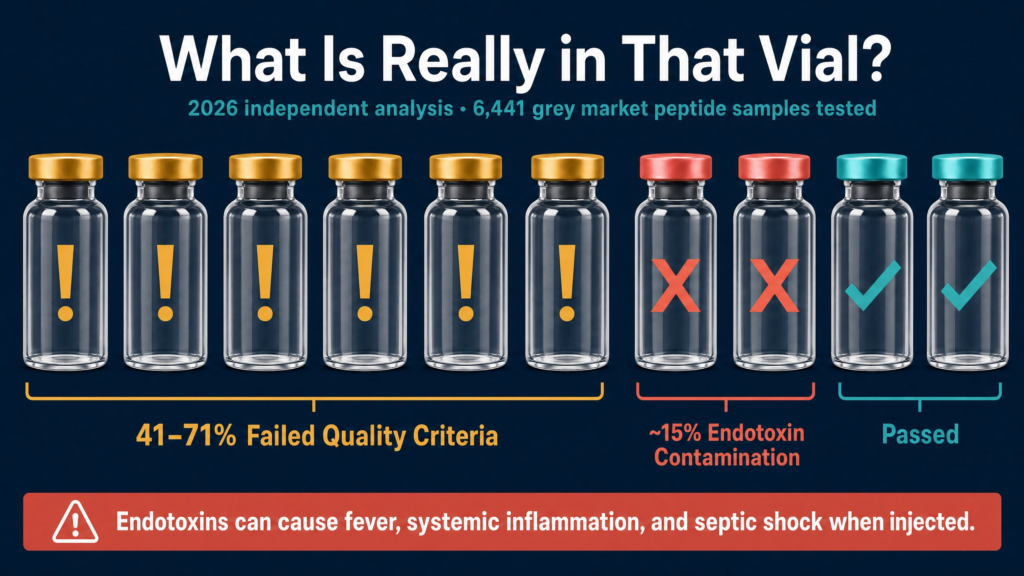
Endotoxins are bacterial byproducts that, when injected, can cause fever, systemic inflammation, and in severe cases, septic shock. Inaccurate dosing, where the actual peptide content differs significantly from the labeled amount, was also common.
These are not theoretical risks. They are documented findings from independent laboratory testing of products actively being purchased and self-administered by consumers.
Anyone considering these compounds should discuss the potential risks, current regulations, and available evidence with a qualified healthcare provider.
✓ The Verdict
As of 2024, BPC-157 and TB-500 were removed from the FDA’s list of bulk drug substances eligible for compounding and are not legally available for human use in the US. This is not a recommendation to use either compound.
Research has explored them together because their mechanisms may be complementary. BPC-157 is studied for localized tissue repair and blood vessel formation, while TB-500 is studied for cellular movement and broader healing processes. However, human safety data remains limited, potential risks are not fully understood, and product quality can vary widely. Anyone considering these compounds should consult a qualified healthcare provider about current regulations and safety concerns.
Scientific References
- McGuire FP, Martinez R, Lenz A, Skinner L, Cushman DM. Regeneration or Risk? A Narrative Review of BPC-157 for Musculoskeletal Healing. Current Reviews in Musculoskeletal Medicine. 2025;18(12):611-619.
- Goldstein AL, Hannappel E, Kleinman HK. Thymosin beta4: actin-sequestering protein moonlights to repair injured tissues. Trends in Molecular Medicine. 2005;11(9):421-429.
- Mendias CL, Awan TM. Evaluation of research grade peptides marketed directly to consumers reveals extensive variability in purity and measured abundance. Preprints. 2026. doi:10.20944/preprints202604.1748.v1.
Legal & Medical Disclaimer
The information provided on this page by PeptideMatch.io is intended solely for educational and informational purposes. It does not constitute, and should not be interpreted as, professional medical advice, diagnosis, or treatment. Always consult a licensed physician or qualified healthcare provider before beginning any peptide therapy or making changes to an existing treatment plan. PeptideMatch.io does not prescribe, dispense, or endorse any specific therapeutic protocol. Individual results may vary, and no outcomes are guaranteed.
©2026 PeptideMatch.io. All Rights Reserved. This educational content is the exclusive intellectual property of PeptideMatch.io. Reproduction, distribution, republication, or transmission of this material, in whole or in part, in any form or by any means, is strictly prohibited without the prior written consent of PeptideMatch.io. For licensing or reprint inquiries, please contact content@peptidematch.io.

BPC-157 is a synthetic 15 amino acid peptide based on a sequence found in human gastric juice. In preclinical research it promotes localized healing by stimulating angiogenesis, the formation of new blood vessels, and is studied for tendons, ligaments, and the gastrointestinal tract. TB-500 is a synthetic version of thymosin beta-4 that regulates actin to help cells migrate to injured areas, and is studied for broader, systemic tissue repair. In short, BPC-157 is studied as a localized repair agent and TB-500 as a more systemic one.
The FDA has not approved either for human use. As of 2024, both were removed from the FDA’s list of bulk drug substances eligible for compounding, so they are not legally available for human use in the US and access through regulated compounding pharmacies is restricted. A licensed healthcare provider can explain the current regulatory status.
Because the two peptides act through different mechanisms, localized blood vessel formation versus systemic cellular migration, they are frequently studied together for more comprehensive recovery. This reflects research interest rather than a treatment recommendation: both are unapproved, are not legally available for human use in the US, and carry unresolved safety questions, Any consideration should involve a qualified provider.
In animal studies both have generally been well tolerated, with mild reported effects such as injection site reactions, fatigue, headaches, and nausea. The more serious concerns are that both act through pathways linked to tumor growth, that no large-scale human trials exist, and that grey market products are frequently contaminated or inaccurately dosed. A 2026 analysis found that 41.6% to 71.1% of consumer peptide samples failed quality criteria, with 15% showing endotoxin contamination.
It depends on the injury. BPC-157 is most often studied for acute, localized injuries such as a torn tendon or strained muscle because it drives blood flow and targeted healing to a specific area. TB-500 is studied for broader, systemic recovery and for multiple sites of damage. Neither is FDA approved, so a qualified provider should guide any decision.
Related Posts
What happens when you combine therapeutic peptides? The biology behind peptide
Your body makes natural peptides that send signals fast, but they disappear almost as quickly as they arrive. Here's how
The story of peptides is filled with brilliant minds, happy accidents, and a few venomous lizards along the way. Discover how
Ready to take the next step?
Find a verified peptide therapy provider or list your practice and connect with patients actively seeking trusted care.